The fight at the seashore and Pinocchio’s arrest
The Adventures of PinocchioThe fight at the seashore and Pinocchio’s arrest is a turning point in which a prank about the Shark escalates into violence, Eugene is struck by a book meant for Pinocchio, and Pinocchio’s remorse is followed almost immediately by another attempt to escape responsibility. The episode makes the cost of his disobedience physical and public: he reaches the shore with his schoolmates, leaves one of them senseless, and is taken away between Carabineers before he can explain himself or return to The Fairy with Azure Hair’s house.
The prank that starts the fight
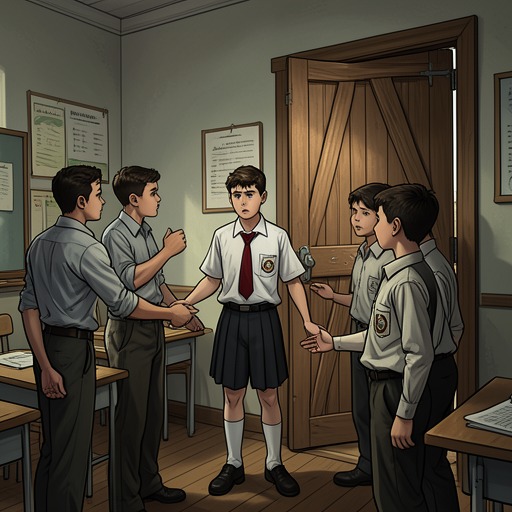
The episode begins with Pinocchio racing to the shore ahead of the other boys. He looks for the Shark but sees only a smooth sea. His companions answer his search with jokes, suggesting that the creature has gone to breakfast or to sleep. From their laughter, Pinocchio realizes they have played a trick on him. The discovery changes the mood of the gathering: what had brought the boys together becomes a confrontation, and Pinocchio demands to know what the joke is.
The boys continue to taunt him, dancing around the Marionette and making threats. The boldest strikes Pinocchio on the head. Pinocchio answers with a blow of his own, and the exchange becomes a full fight. Though alone against the group, he defends himself with his wooden feet, moving fast enough to keep the others at a distance. Their books, thrown at him one after another, fly past and land in the sea. The detail turns school materials into weapons and gives the quarrel a sharp irony: Pinocchio has come away from school with the books, but not the obedience that might have kept him from the shore.
Eugene is struck by the arithmetic book
Once the boys have used up their own books, they seize Pinocchio’s nearby bundle for more ammunition. Among its contents is a large, leather-bound arithmetic book, the one Pinocchio values most. A boy hurls it with all his strength at Pinocchio’s head. It misses him and strikes Eugene, who cries out to his mother and falls senseless. The injury is accidental in its immediate aim, but it follows from the boys’ decision to turn books into missiles and from Pinocchio’s choice to join the fight.
The other boys flee at the sight of Eugene lying pale and motionless. Pinocchio does not run with them. Frightened by what has happened, he goes to the sea, wets his handkerchief, and bathes Eugene’s head. He sobs and calls to him, insisting that he was not the one who threw the book and pleading for him to open his eyes. His words expose the distance between blame for the particular throw and responsibility for the circumstances: Pinocchio did not cast the book, yet he has been part of the brawl that brought Eugene to harm.
Remorse and the Carabineers’ decision
While tending Eugene, Pinocchio turns his fear inward. He wonders how he can face his mother and where he can hide, then laments that he should have gone to school rather than listening to the boys. He recalls the warning to beware of bad company and recognizes that he has repeatedly heard advice without following it. His account is not a calm lesson learned once and for all: he calls himself stubborn and proud, admits that he does as he wishes, and sees the painful consequences arriving again.
Heavy steps interrupt his lament. Two Carabineers reach the scene and ask what Pinocchio is doing on the ground. He answers their questions, but they cut off further explanation and order him to get up and come with them. Before leaving, they call to fishermen passing in a boat, asking them to care for the injured boy, take him home, and bind his wounds; they say they will return for him the next day. The officers therefore arrange for Eugene to receive care while taking Pinocchio into custody. Pinocchio walks between them toward the village, bewildered and physically shaken, and worries especially about passing The Fairy with Azure Hair’s windows in their company.
The escape attempt and its consequence
On the road, Pinocchio asks permission to run after his cap. The Carabineers allow him to go, telling him to hurry. He picks the cap up but does not put it on: he holds it between his teeth and races toward the sea. The small, practical pretext becomes an immediate flight, contradicting the remorse he has just expressed. Even after recognizing how his disobedience led him into trouble, he acts again on impulse when an opportunity opens.
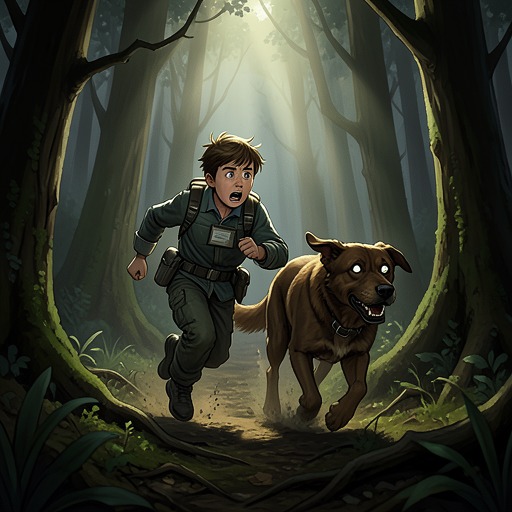
The Carabineers judge that catching him will be difficult and send a large Mastiff after him, a dog that has won first prize in dog races. The chase draws people to their windows and into the street, but the runners raise so much dust that the crowd soon cannot see either of them. Pinocchio’s arrest thus ends not with a settled explanation of Eugene’s injury, but with another pursuit. The episode links a public consequence to a repeated pattern: warning ignored, danger encountered, regret voiced, and escape attempted before the regret can become lasting change.
Narrative significance
The chapter’s title identifies both the fight and the arrest, but the episode gives each a distinct turn. The fight begins as a group’s joke, becomes reciprocal violence, and leaves Eugene injured by a book thrown by another boy. Pinocchio’s compassionate effort to revive him complicates any simple picture of him as merely callous or malicious; his self-reproach shows that he can recognize the bad choice even while he remains unable to act consistently on that recognition.
The narrator has already warned that dreadful consequences await Pinocchio because of his disobedience. The scene fulfills that warning through concrete reversals: the schoolbooks become weapons, the book Pinocchio prizes most strikes his schoolmate, and his attempt to reach the shore ends with officers escorting him away. Yet remorse does not close the sequence. His flight with the cap in his teeth renews the story’s tension between understanding advice and obeying it, while the pursuit carries the danger of this episode into what follows.